AI Techniques for Michigan Marketers: Content, Ads, Analytics and Email
AI techniques for Michigan marketers can save a small team hours every week on content, ads, analytics and email. This guide shows how, with practical examples from Detroit to the Upper Peninsula.
Written by Jordan McKinney, updated October 27, 2026

- AI techniques for Michigan marketers work best on repetitive tasks such as first drafts, ad variations, report summaries and email segments.
- Give AI a clear brief with your audience, city and offer to get locally relevant output.
- Plan seasonal content and ads around Michigan weather and travel seasons.
- Never paste customer personal data into public AI tools, and have a person review everything before it goes out.
Why AI techniques for Michigan marketers matter now
AI techniques matter for Michigan marketers because they let small teams produce more content, ads and reports without adding staff. Michigan marketers juggle very different audiences. A Detroit home-services company, a Grand Rapids brewery and a resort in the Upper Peninsula all sell to people with different needs, seasons and budgets, and most of them run with small teams. The most useful AI techniques for Michigan marketers take on the repetitive parts of the job: first drafts, ad variations, report summaries and email segments. That frees people to spend their time on the decisions that need local knowledge and judgment.
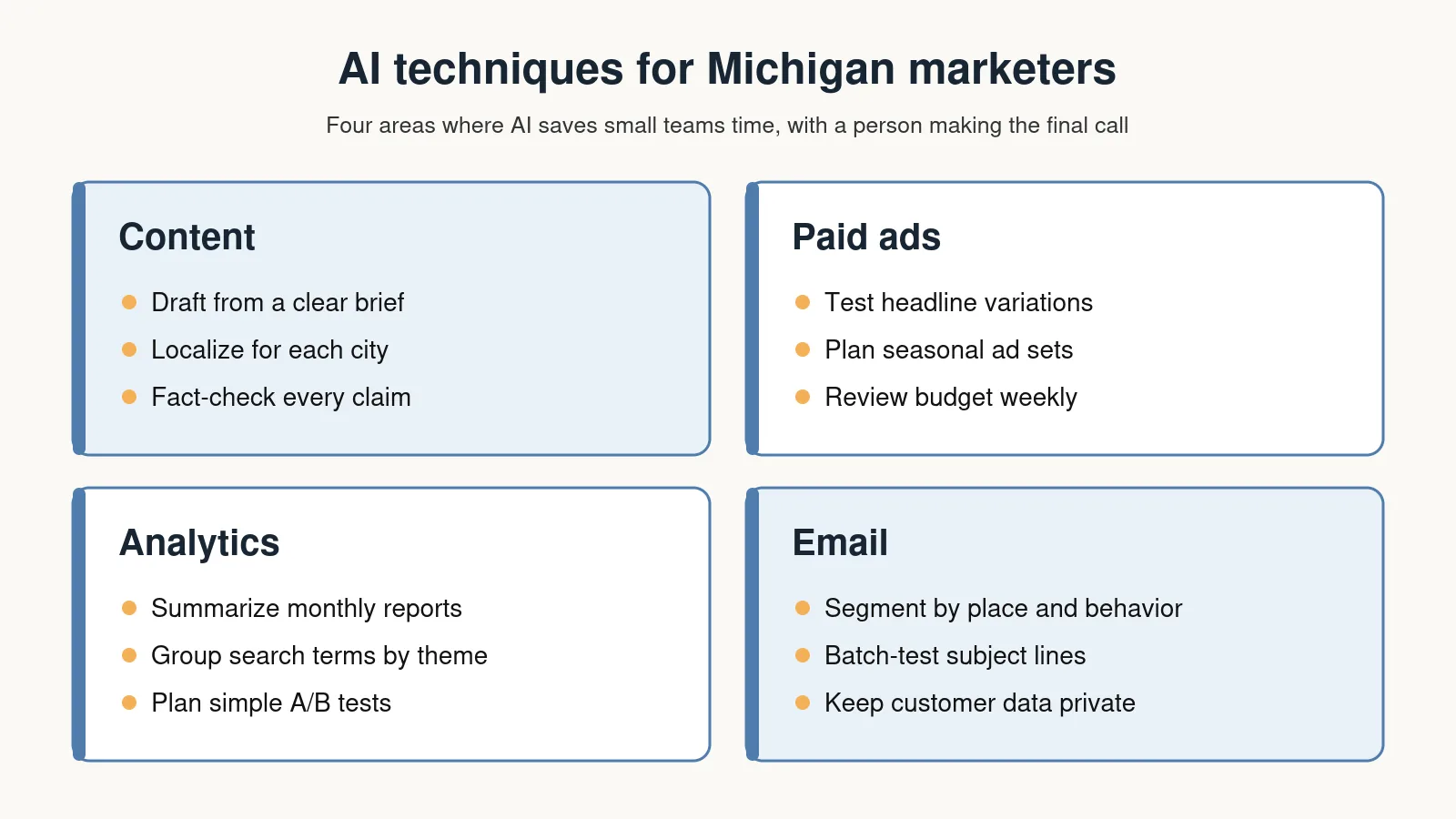
This guide covers four areas where AI techniques pay off quickly for Michigan marketers: content, paid ads, analytics and email. Each section includes a Michigan example and a simple way to start. The goal of using AI for small business marketing is not to replace marketers but to give a small team the output of a bigger one, without losing the voice that makes a local business feel local.
This page covers everyday marketing work. If your main goal is ranking in Google, start with the guide to Michigan SEO tactics with AI workflows.
AI is already part of most marketing teams. In HubSpot’s 2026 State of Marketing report, 86.4% of marketing teams said they use AI in at least a few marketing areas. That shift matters for Michigan’s 983,079 small businesses (SBA Office of Advocacy, 2025), which often compete against companies with much larger marketing budgets.
AI techniques for content creation
The best way to use AI for content is as a research assistant and drafting partner, with a person editing and fact-checking the final version. Content is where most teams start with AI, and it is also where quality slips fastest if nobody edits the output.
Content is the most common place to start. In the same HubSpot report, 42.5% of marketers said they use AI extensively for content creation.
- Brief before you draft. Give the tool your audience, location, offer and tone in a short brief. “Write a blog post about patios” produces generic copy. “Write for homeowners in Oakland County planning a spring patio, friendly tone, mention freeze-thaw cycles” produces something a reader in Troy or Rochester Hills will recognize.
- Repurpose one strong piece. Turn a long guide into social posts, a newsletter section and a short video script. One well-researched article can feed a month of channels.
- Localize, don’t duplicate. Use AI to adapt a core message for different cities, then add genuinely local details yourself, such as neighborhoods, events and landmarks.
- Fact-check every claim. AI tools can invent statistics and business details. Verify anything specific before it goes live.
Michigan example: a Traverse City bed and breakfast could ask an AI tool to outline a seasonal series covering cherry season in July, fall color drives on the Leelanau Peninsula and quiet winter getaways. The owner then fills each outline with their own photos, recommendations and guest stories.
You are helping a bed and breakfast in Traverse City, Michigan. Write an outline for a blog post about fall color drives on the Leelanau Peninsula for couples planning an October weekend. Use a friendly tone and five H2 headings, and list three local details I should add myself. Do not invent prices, dates or business names.
Click the prompt once to select all of it, then copy and paste it into your AI tool. Replace the details with your own.Can AI write my Google Ads?
Yes. AI can write Google Ads headlines and descriptions in seconds, which makes it much easier to test more versions, but a person should still choose what runs, check every claim and control the budget. Paid search and social ads reward testing, and testing takes time to set up. AI advertising tools speed up the slow parts so you can run more experiments on the same budget.
- Generate headline and description variations. Ask for ten versions of an ad built around a single benefit, then pick the strongest three to test. Most ad platforms now include built-in AI suggestions as well.
- Build clearer audiences. Use AI to summarize customer reviews and survey answers into short audience descriptions, then shape targeting and messaging for each group.
- Match ads to the season. Michigan demand swings with the weather. Draft separate ad sets for the first cold snap, the spring thaw and summer travel, and schedule them ahead of time.
- Keep a person on the budget. Let automated bidding do its work, but review spend, search terms and placements every week.
Michigan example: a Metro Detroit HVAC company could prepare “furnace tune-up” ads for September and “emergency furnace repair” ads that switch on when overnight temperatures drop, with AI-written variations tested for each.
Write 10 Google Ads headlines (30 characters or fewer) and 4 descriptions (90 characters or fewer) for a Metro Detroit HVAC company promoting furnace tune-ups in September. Focus each headline on one benefit, mention Metro Detroit in at least three headlines, and avoid claims I cannot prove, such as "best" or "cheapest."
Click the prompt once to select all of it, then copy and paste it into your AI tool. Replace the details with your own.How can AI help me understand my marketing reports?
AI can turn long reports and search term lists into short, plain-language findings you can act on. It is one of the most practical AI techniques for Michigan marketers, as long as you check every number against the original data. Most small teams have more data than time to read it. AI techniques help turn reports from Google Analytics, Search Console and ad platforms into plain-language findings and next steps.
- Summarize reports. Export a monthly report and ask an AI tool to list the biggest changes, likely causes and questions worth checking. Always confirm the numbers against the original data.
- Find patterns in search terms. Group hundreds of search terms into themes such as price, location and urgency to see what customers actually ask for.
- Analyze customer feedback. Paste in anonymized reviews or survey answers and ask for recurring praise and complaints.
- Plan simple tests. Ask for a clear hypothesis and success measure before you change a landing page, so the results are easy to judge.
Michigan example: an Ann Arbor dental practice could have AI group its search terms and discover that many visitors look for weekend appointments, a gap worth addressing on its booking page.
Here is last month's search term report from an Ann Arbor dental practice's Google Ads account: [paste the data]. Group the search terms into 5 to 7 themes, show total clicks for each theme, and name the three themes that most need their own landing page. Flag search terms that look like wasted spend. Use only the data I gave you.
Click the prompt once to select all of it, then copy and paste it into your AI tool. Replace the details with your own.AI techniques for email marketing
AI makes email marketing more relevant by helping you segment your list, test subject lines and adapt one message for different audiences. Email remains one of the most reliable channels for local businesses because you own the list. AI techniques make it easier to send relevant messages without writing every one from scratch.
- Segment by behavior and place. Use AI to suggest segments from purchase history and location, for example West Michigan customers versus Metro Detroit, or first-time buyers versus regulars.
- Draft subject lines in batches. Generate several subject lines for each send and A/B test two of them.
- Personalize at scale. Write one core email, then use AI to adapt the opening line and offer for each segment.
- Protect privacy. Don’t paste customer names, email addresses or other personal data into public AI tools. Work with anonymized or combined data instead.
Michigan example: a Lansing outdoor-gear shop could send one spring newsletter with different lead stories for anglers, paddlers and campers, each drafted with AI and edited by staff who know the local rivers and trails.
Write three versions of the opening paragraph for a spring newsletter from a Lansing outdoor-gear shop: one for anglers, one for paddlers and one for campers. Keep each under 60 words and mention a type of Michigan river or trail. Then suggest five subject lines under 50 characters. Do not include any customer names.
Click the prompt once to select all of it, then copy and paste it into your AI tool. Replace the details with your own.Which AI tools should a small business start with?
The best AI tools to start with are a general AI assistant for writing and research, a design tool for visuals, and the AI features already built into your email and ad platforms. Most of these AI marketing tools have a free option, so a small Michigan team can test them before paying for anything.
Your customers are using these tools too: 34% of U.S. adults have used ChatGPT, including 58% of adults under 30, according to Pew Research Center (2025).
| Tool | Good for | Free option | Paid plans |
|---|---|---|---|
| ChatGPT OpenAI | Drafting, brainstorming and summarizing | Yes | Go $8/month; Plus $20/month |
| Claude Anthropic | Long documents, editing and analysis | Yes | Pro $17/month, billed annually |
| Gemini | Drafting and research with a Google account | Yes | From $4.99/month; Google AI Pro $19.99/month |
| Canva Canva | Social graphics, flyers and quick designs, with AI features | Yes | Pro US$144/year for one person |
| Mailchimp Intuit Mailchimp | Email marketing, with generative AI features | Yes | From $13/month; price rises with your contact count |
| Google Ads | Search and display ads, with built-in AI suggestions | No subscription | No flat fees; you pay for your ads (search ads are pay-per-click) |
Pricing checked October 2026. Prices and plan names change often, so confirm on each tool’s pricing page (linked in the table) before you buy.
How do I keep AI content accurate and on-brand?
Have a person check every fact, offer and price, and read the copy for tone, before anything AI-assisted is published or sent. AI techniques work best inside a simple process. You can see the process this site follows in how I use AI and review every page. Before anything is published or sent, a person should check the facts, confirm offers and prices, read the copy aloud for brand voice, and make sure it follows platform rules and privacy law. Keep a shared document with prompts that worked well, the brand’s tone guidelines and approved Michigan-specific details, so everyone on the team gets consistent results.
Review replies are a good example of where the human step matters. In BrightLocal’s 2026 survey, 80% of consumers said they are likely to use a business that responds to all of its reviews. AI can draft those replies quickly, but each one should be personal and checked before it is posted.
Frequently asked questions
What are the most useful AI techniques for Michigan marketers?
Drafting content from a clear brief, generating ad variations for testing, summarizing analytics reports and personalizing email for different segments. These save the most time for small teams while leaving the decisions to people.
Do I need paid AI tools to get started?
No. Many free or low-cost AI assistants can handle drafting, summarizing and brainstorming, and most ad and email platforms now include built-in AI features. Start with what your team already uses before adding new subscriptions.
Is it safe to put customer data into AI tools?
Avoid pasting names, email addresses or other personal information into public AI tools. Use anonymized or combined data, and check the tool’s privacy settings and your company’s policies first.
How can a small Michigan business tell whether AI is helping?
Pick one task, such as the weekly email or ad testing, and track the time spent and the results before and after using AI. Compare open rates, click-through rates or leads over a few months to decide whether the change is worth keeping.
Where to go next
This page focuses on everyday marketing work. To see how AI fits into search rankings specifically, read our guide to Michigan SEO tactics with AI workflows. AI digital marketing tools and prices change quickly, so I will keep this page updated as they do.
Sources
- HubSpot. 2026 State of Marketing: Data from 1,500+ global marketers. 2026.
- Pew Research Center. 34% of U.S. adults have used ChatGPT, about double the share in 2023. June 25, 2025.
- U.S. Small Business Administration, Office of Advocacy. 2025 Small Business Profile: Michigan. June 2025.
- BrightLocal. Local Consumer Review Survey 2026. 2026.
- Tool pricing pages, checked October 2026: ChatGPT, Claude, Gemini, Canva, Mailchimp and Google Ads.