Michigan SEO guide
Michigan SEO Tactics with AI Workflows
Michigan SEO tactics with AI workflows help small businesses get found in Google faster, with a person checking every step. This student-built guide walks through the whole process, from keyword research to local search.
Written by Jordan McKinney, updated October 27, 2026
- Use AI for keyword ideas, but confirm search volume in Google Keyword Planner before choosing a target.
- Give every page one clear topic, one H1, and a keyword-focused title and meta description.
- Local SEO for Michigan businesses depends on a complete Google Business Profile and genuinely local page content.
- A person should fact-check every AI-assisted page before it is published.
How Michigan SEO tactics with AI workflows fit together
They combine the speed of AI tools with the judgment of a person who knows the local market. The most reliable way to use AI for SEO is to give it narrow jobs inside a repeatable process: finding keyword ideas, drafting page titles, outlining content briefs and checking pages for gaps. A person then verifies the data, adds local detail and decides what gets published.
Most of the competition is local and small. Michigan has 983,079 small businesses, 99.6% of all businesses in the state, and they employ 47.7% of Michigan workers, according to the SBA Office of Advocacy’s 2025 Michigan profile. Many of them are chasing the same local searches, which is why a repeatable, well-checked SEO process is worth building.
This guide focuses only on search: how Michigan businesses can rank in Google, show up in the map results and get cited in AI-generated answers. For broader uses of AI in content, ads, analytics and email, see our guide to AI techniques for Michigan marketers.
- Keyword ideas
- Volume check
- Content brief
- Draft
- Human review
- Publish and track

Photo: Detroit skyline by William Duggan on Unsplash
Can AI find the right keywords for my business?
AI can find good keyword ideas, but it cannot tell you how many people actually search for them. Use AI to build the list, then confirm real search volume in Google Keyword Planner before you pick a target. AI tools are good at brainstorming the ways people describe a problem. Give one your services, the cities you serve and your customers’ common questions, and ask it to list search phrases by intent: people learning, people comparing and people ready to buy. A Kalamazoo roofing company might get ideas like “ice dam repair Kalamazoo,” “how long does a shingle roof last in Michigan” and “roof replacement cost Portage.”
AI tools do not have reliable search volume data, and they sometimes invent numbers. Paste the list into Google Keyword Planner, which is free with a Google Ads account, to see real monthly searches and competition, then keep the phrases with meaningful demand. Group close variations together so each group becomes one strong page instead of several thin ones.
On-page SEO tactics AI can help with: titles, headings, meta descriptions and links
AI can draft title tags, meta descriptions, heading outlines and internal link suggestions, but a person should approve each one. Once you know which keyword a page targets, AI SEO tools can speed up the on-page work. Ask it for five title tag options under 60 characters with the keyword near the front, and a meta description under 155 characters that tells searchers what they will get. Ask it to check that the page has one H1, that the H2s follow a logical order and that the keyword appears naturally in the first paragraph.
Internal links are easy to overlook. Give AI a list of your page titles and URLs and ask which pages should link to each other and with what anchor text. A Grand Rapids accounting firm, for example, could link its small-business tax page to its guide on quarterly estimated taxes for Michigan LLCs using that descriptive phrase rather than “click here.”
Should I write a brief before letting AI draft a page?
Yes. A short content brief tells AI exactly what a page must cover, so the draft comes out more focused and is faster to fact-check. AI can build the brief itself in minutes from your keyword research. The biggest quality gains come before any writing starts. A content brief tells the writer, human or AI, exactly what the page must cover. Ask AI to build one from your keyword group that includes the main question the page answers, the search intent, the subtopics competing pages cover, questions to answer directly, local details to include and internal links to add.
A Traverse City vacation rental company writing about things to do in Traverse City in winter might use a brief that lists cross-country ski trails, winter access to Sleeping Bear Dunes, downtown events and driving conditions, plus a note to add the owner’s own recommendations. The brief keeps the draft focused and makes the human review faster.
How do I show up in Google Maps for my city?
To show up in Google Maps, start with a complete Google Business Profile, consistent contact details everywhere online and a steady flow of recent reviews. That is the core of local SEO for Michigan businesses, and city pages help only when they include genuinely local content. A simple checklist for local SEO in Michigan: claim your profile, keep your name, address and phone number identical everywhere, and reply to every review. For businesses that serve customers in person, the Google map results often matter more than the regular listings. Keep your Google Business Profile complete, with the right categories, hours, service areas and photos, and ask happy customers for reviews. AI can draft review replies and short weekly profile updates, but edit them so they sound like your business.
Make sure your business name, address and phone number match everywhere they appear online. If you serve several areas, such as a Detroit HVAC company covering Dearborn, Livonia and Royal Oak, build a page for an area only when you have something specific to say about it, like local projects, response times or staff. Pages that only swap the city name rarely rank and can weaken the rest of the site.
Reviews are a big part of local SEO. In BrightLocal’s 2026 Local Consumer Review Survey, 97% of consumers said they read reviews for local businesses, 74% look for reviews written in the last three months, and 31% will only use a business rated 4.5 stars or higher. A steady flow of recent reviews, with a thoughtful reply to each one, helps your listing stand out in the map results and win the click.
Does SEO work differently in Detroit than Up North?
Yes. The basics of SEO are the same statewide, but search behavior changes by region: Metro Detroit searches are crowded and suburb-specific, West Michigan shoppers lean toward local businesses, Mid-Michigan follows the school and government calendar, and Northern Michigan and the U.P. rise and fall with the travel seasons. Use the table below as a starting point when you plan keywords and pages for each area.
| Region | Main cities | How search tends to differ | SEO focus |
|---|---|---|---|
| Metro Detroit and Ann Arbor | Detroit, Dearborn, Warren, Troy, Ann Arbor | Many competitors for each service, and people often search by suburb or neighborhood, such as "roof repair Royal Oak." | Build pages for the specific suburbs you serve and ask for reviews that mention the area. |
| West Michigan | Grand Rapids, Kalamazoo, Holland, Muskegon | Shoppers often look for local and independently owned options and compare reviews closely before choosing. | Highlight local ownership and community ties, and keep your Google Business Profile full of recent reviews and photos. |
| Mid-Michigan | Lansing, East Lansing, Flint, Saginaw, Midland | Demand follows the school year, state government and large employers, with many searches from students and commuters. | Time content to the academic calendar and target "near campus" and commuter-route searches. |
| Northern Michigan and the U.P. | Traverse City, Petoskey, Marquette, Sault Ste. Marie | Searches rise and fall with summer travel, fall color and winter sports, and many come from people planning trips from downstate or out of state. | Publish seasonal pages early, keep hours current, and answer trip-planning searches like "things to do in Marquette in winter." |
The patterns above are practical planning guidance based on each region’s economy and seasons, not measured search data. Check Google Search Console and Keyword Planner for the real search terms in your area.
Tourism is a big reason seasonality matters here. Michigan welcomed 131.2 million visitors in 2024, and they spent $30.7 billion, according to Travel Michigan. If your business serves visitors, your busiest search months may be very different from a business that serves only local residents.
Get cited in Google AI Overviews and AI chatbots
To get cited in Google AI Overviews and AI chatbots, answer common questions directly near the top of the page and include specific facts that are easy to quote. More searches now end with an AI-generated summary, and those summaries cite sources. Pages that get cited tend to answer a question directly near the top, use clear headings that match how people ask, and include specific, checkable facts such as prices, timeframes, locations and steps.
A Marquette outdoor outfitter could answer “When is the best time to see fall colors in the Upper Peninsula?” in its first two sentences, then add a short list of routes and typical peak weeks. Keep facts current, show a clear business or author name, and use FAQ sections for common questions. Nothing guarantees a citation, but clear, quotable answers make your page an easy source to use.
Keep a human reviewer in the workflow
Every AI-assisted page needs a person to fact-check it before publishing, because AI tools can state wrong information confidently. The review should cover a few basics: check names, numbers, addresses and claims, confirm that local details are accurate, remove generic filler and read the page the way a customer would. An Ann Arbor dental practice, for example, should have someone confirm insurance, hours and treatment details rather than trusting a draft.
Keep a simple checklist and a log of what changed on each page and when. That record makes it easier to see which updates moved rankings in Google Search Console, and it keeps the whole workflow accountable.
How I built this site with an AI SEO workflow
I’m Jordan McKinney, and I built MI Marketing Lab for a ranking project in MKT-363 at UM-Dearborn. Here is how the site was made, including the parts that did not go to plan.
Picking and checking keywords. The two keywords, “Michigan SEO tactics with AI workflows” and “AI techniques for Michigan marketers,” were assigned in class. To see what I was up against, I Googled both in an incognito window and studied the sites ranking at the top, including mansonmarketmetrics.com and johnstavolamarketing.com. On October 27, I checked my keywords in Google Keyword Planner (Michigan, English, last 12 months). Both exact keywords showed only 0–10 monthly searches in Michigan in Google Keyword Planner, so I used related terms with 10–100 and 100–1K monthly Michigan searches, such as “AI for SEO,” “local SEO Michigan” and “AI marketing tools,” to shape the pages.
Building the pages. I built and edited the pages with Claude Code, an AI coding assistant, working in WordPress with Elementor and the Astra theme. AI drafted layouts, content and fixes, and I reviewed every change myself before it went live, including the facts, the tone and how each page looks on a phone.
Setting up the tools. On October 26, I finished the Yoast SEO setup wizard, set up Site Kit by Google, connected Search Console and Analytics, submitted the XML sitemap and used URL Inspection to confirm both main pages were indexed.
Keeping a ranking with 301 redirects. When I Googled my keywords on October 26, I found one of my old test posts ranking at #3 for “AI techniques for Michigan marketers.” I had just set that post to draft, which would have turned the ranking URL into a dead page. Instead, I had 301 redirects set up so the old URLs point to the matching pages on this site, which should let most of that ranking credit carry over.
Studying competitors. I compared my pages with the top competitors to see what they did better. Instead of copying their wording or layout, I added statistics I checked at the original sources, a Sources list on each page, and practical extras like copy-ready prompts and a regional table.
This site is still a work in progress, and I will update this section as I learn what actually moves the rankings.
AI Marketing Resources

How Michigan teams use AI for content, paid ads, analytics and email, with local examples.
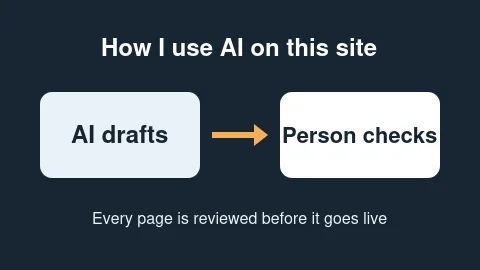
How AI helps with research and drafting here, and how every page is reviewed and fact-checked before it goes live.

Keyword Planner shows zero for your keyword? See how I used broader seed keywords to find related terms with real search volume and match them to my pages.
Frequently asked questions
What are Michigan SEO tactics with AI workflows?
They are repeatable SEO processes where AI handles narrow tasks, such as keyword ideas, title drafts and content briefs, while a person verifies the data and adds local knowledge. The goal is faster SEO work without losing accuracy.
Can AI tools tell me how many people search for a keyword?
Not reliably. AI tools often estimate or invent search volumes, so use Google Keyword Planner or another keyword tool for real monthly search data. Use AI for generating and grouping ideas instead.
How long does it take to see SEO results for a Michigan business?
Most new or updated pages take several weeks to a few months to show steady ranking changes. Local businesses with a complete Google Business Profile and a steady flow of reviews often see map results improve sooner than regular rankings.
Will AI-written content hurt my rankings?
Google looks at whether content is helpful and accurate, not at how it was produced. Generic or inaccurate pages published without review tend to perform poorly, so a person should edit and fact-check every page.
How do I get my business cited in Google AI Overviews?
Answer common questions directly near the top of a page, use clear headings and include specific facts that are easy to quote. There is no guaranteed method, but current, accurate and clearly written answers make your page easier to cite.
Sources
- U.S. Small Business Administration, Office of Advocacy. 2025 Small Business Profile: Michigan. June 2025.
- BrightLocal. Local Consumer Review Survey 2026. 2026.
- Travel Michigan, Michigan Economic Development Corporation. Michigan’s Tourism Industry Generates $54.8 Billion in Economic Impact. July 29, 2025.
Continue to the next guide
Read: AI techniques for Michigan marketers